
Why Collaboration Between Bowling Coaches and S&C Specialists is the Key to Unlocking Player Potential
Find a good Strength & Conditioning Coach to make real skill improvements

In cricket coaching, especially fast bowling, it’s easy to observe a technical issue and identify the changes needed for better skill execution. However, the real question - and the one that truly drives improvement - is: “How can I change that?”.
For players to implement consistent technical adjustments, they need more than observation, they need a roadmap for physical change. This is where collaboration between bowling coaches and Strength & Conditioning (S&C) specialists becomes crucial.
The Key to Effective Technical Change
The best coaches understand that behind every technical change is a necessary physical adjustment. It’s not enough to tell a bowler to adjust their arm path or foot placement without addressing the physical capabilities required to achieve those changes.
For instance, improving ankle stiffness, running mechanics, or core strength may be the hidden factors that enable a bowler to reach the desired technical position.
Movement Efficiency as a Foundation
Efficient movement is the bedrock of effective fast bowling. S&C coaches play a vital role in this area by designing programmes that target key movement fundamentals:
Running Mechanics: Drills like marches, switches, and straight-leg bounds develop knee drive and ensure the bowler lands correctly on the ball of the foot, maximising energy transfer.
Ankle Stiffness: Isometric holds and plyometric exercises strengthen tendons, helping bowlers absorb and reapply force more effectively, resulting in smoother transitions and explosive movements.
When bowling coaches and S&C specialists work together, bowlers can carry momentum through the crease rather than working against their body’s natural movement patterns.
A Real-World Example: Jasprit Bumrah's Seamless Evolution
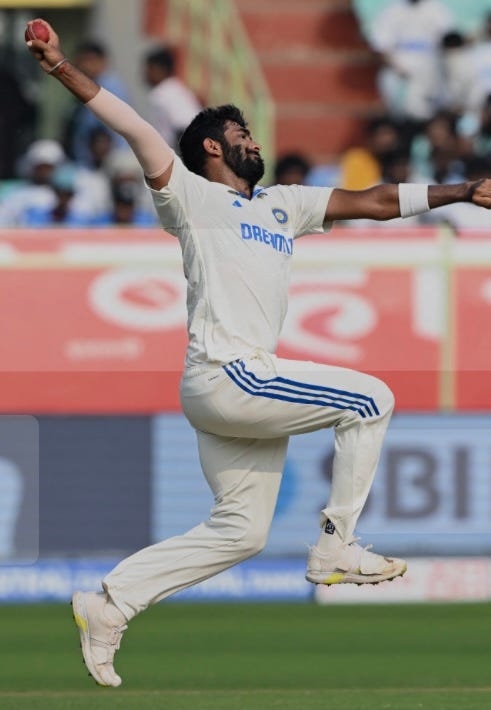
A prime example of this collaborative approach is Indian fast bowler Jasprit Bumrah, widely regarded as one of the best in the world.
Early in his career, Bumrah’s unconventional action placed significant strain on his lower back and ankle due to his sharp lateral movements and braced front leg. The goal was to maintain his unique action and lethal pace while reducing injury risk and improving his efficiency through the crease.
To achieve this, Bumrah’s coaching team, in collaboration with S&C specialists, focused on improving his ankle stiffness and overall lower-body strength.
The S&C team prescribed isometric holds, single-leg eccentric exercises, and plyometric drills to build tendon resilience and improve shock absorption.
Concurrently, his bowling coach made slight adjustments to his run-up and landing stride to help him maximise forward momentum and reduce unnecessary side-loading forces.
The result? Bumrah retained his signature action and speed but became more efficient in his movement, significantly reducing time spent on the back foot and allowing a smoother energy transfer through his front foot.
This approach not only enhanced his performance but also contributed to his remarkable consistency across formats.
The Power of Asking “How?”
Encouraging bowlers to ask, “How can I change that?” fosters a mindset of growth and accountability.
When players ask this question, it opens the door for deeper conversations between technical and S&C coaches, making the adjustment process more collaborative and effective.
For example, if a player is told to “stay taller” during their gather, they might need specific mobility or strength improvements to achieve this.
An S&C coach’s understanding of the physical requirements behind the adjustment ensures the player has the necessary tools to meet the technical demands of their coach.
Challenges at the Club Level
In professional environments, access to S&C specialists who understand cricket is common.
However, in club cricket, this access can be limited, presenting a challenge for club coaches who often work alone and may lack the expertise to prescribe the required physical interventions.
To help bridge this gap:
Education and Collaboration: Club coaches can benefit from building relationships with S&C coaches, whether online or locally, who are keen to understand the nuances of the bowling action.
Resource Sharing: Providing club-level coaches with S&C programmes tailored to cricket-specific needs can empower them to incorporate physical development into their training. Even simple, foundational programs can make a significant impact.
Athlete Understanding: Players at all levels should be encouraged to take ownership of their physical preparation and understand how it supports their technical growth.
The Role of S&C in Skill Execution
Skill execution is not just about technical precision, it’s also about the body’s ability to consistently reproduce good movements under pressure. S&C specialists contribute to this by:
Enhancing power and speed through targeted exercises.
Improving recovery and resilience to withstand longer spells.
Helping bowlers maintain their form late into their run-up and delivery stride.
The Future of Coaching: Integrated Support
The future of cricket coaching at all levels lies in integrated support systems where technical coaches and S&C specialists work as a team, with the player at the core of every conversation.
By understanding their unique roles in a player’s journey and aligning their efforts, coaches can guide bowlers through quicker, meaningful changes.
At the heart of this approach is the player’s ability to ask, “How can I change?” and receive not just an answer but a clear, collaborative path to improvement.
When S&C and technical coaching come together, the result is more than improved performance - it’s sustainable growth and resilience.
Final Thoughts
For any technical change to take root, there must be a corresponding physical adjustment. This is the key ingredient that often gets missed.
Club coaches, despite limited resources, can benefit from partnerships with S&C experts and a clear understanding of the body’s role in skill execution.
Access to the right guidance ensures that technical coaching is not just about what to change but how to change and that makes all the difference.
If you found today’s read valuable, I’d really appreciate it if you shared this article - sharing is how The Huddle grows.
Catch you soon.
Stuart